Go to Page Main Content

bluebar
bluebar
NASAlogo
NASA Goddard Space Flight Center
GLOBAL MODELING AND ASSIMILATION OFFICE
bluebar
bluebar
whitebar
GMAO Mainpage GMAO Research Areas GMAO Systems GMAO Products GMAO Projects GMAO Seminars GMAO Publications
bluebar
whitebar


ABOUT GMAO


GMAO LINKS


NASA LINKS


Begin Main Content

QUICK LINKS

GEOS-5 button
Experimental Forecast Suite button
MERRA Button


WHAT'S NEW


Visualization of 1979 President's Day Snow Storm from MERRA
This visualization shows the development of the severe President's Day 1979 snow storm, generated from MERRA data. See the MERRA page for a description and link to this animation.
+ MERRA page

MERRA product segments now available online at the GES DISC
+ See MERRA Data Access Announcement

New - GEOS-5 Documentation
The complete documentation of the GEOS-5 DAS is now available.
+ " The GEOS-5 Data Assimilation System - Documentation
of Versions 5.0.1, 5.1.0, and 5.2.0 "


NEWS AND RESEARCH HIGHLIGHTS


08.24.2009 - High Resolution GEOS-5 Simulations Included in NASA News Story
High resolution GEOS-5 simulations conducted with the cubed sphere, non-hydrostatic version of the finite volume dynamical core are included in a feature story on new computer capabilities in the NCCS. These simulations have been conducted to test scaling and developments needed to allow GEOS-5 to run on tens of thousands of processsors for high resolution configurations. They are also part of the developments underway for the next generation model, GEOS-6.
+ Read NASA news story

08.19.2009 - GEOS-5-based Visualization Among Wired's Best of 2009
A visualization of a GEOS-5 atmospheric carbon cycle simulation conducted at Oak Ridge National Laboratory (ORNL) has been highlighted in the list of the Best Science Visualization Videos of 2009 by Wired magazine. The visualization was produced at ORNL by Jamison Daniel and David Erickson.
+ Wired Science Article

03.23.2009 - GEOS Chemistry-Climate Model Reveals Effects of Unrestricted CFCs on Stratospheric Ozone
The GEOS Chemistry-Climate Model has been used to show how ozone might have changed by the middle of the 21st Century if use of chlorofluorocarbons had not been restricted. Led by Paul Newman in the Atmospheric Chemistry and Dynamics Branch at NASA GSFC, the paper shows that catastrophic global stratospheric ozone loss has been avoided because nations agreed to implement the Montreal Protocol and its amendments.
+ Read NASA news story

02.5.2009 - Climate Change Impacts Ozone Recovery in the 21st Century
A collaborative study involving GSFC researchers, led by Darryn Waugh at Johns Hopkins University, using Version 1 of the GEOS Chemistry-Climate Model indicates that global warming may likely delay the recovery of stratospheric ozone at some latitudes. An AGU Press Release accompanies the paper, published in GRL on Feb. 5, 2009.

01.11.2009 - MERRA Short Course Given at AMS Meeting
The AMS Short Course on The Modern Era Retrospective-analysis for Research and Applications (MERRA) data and accessibility was held on 11 January 2009 preceding the 89th Annual Meeting in Phoenix AZ.
+ See MERRA Short Course presentations


See: GMAO News Archive


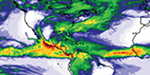
thumbnail of Indonesian aerosols Impact of 2006 Biomass burning aerosols on tropical dynamics studied with GEOS-5
A new study uses the Goddard Earth Observing System, Version 5 (GEOS-5) atmospheric general circulation model to study the impact of aerosols produced by the 2006 Indonesian fires on atmospheric temperature, moisture, and circulation in the region.
+ Read Research Highlight

thumbnail of GEOS-5 CloudSat figure GEOS-5 - CloudSat Intercomparisons
A new study utilizes global analyses of the atmosphere obtained from the new GEOS-5 Data Assimilation System (DAS) developed for GMAO's Modern Era Retrospective-analysis for Research and Applications (MERRA) to examine the relationships between cloud parameters observed by the CloudSat satellite and predictors of convective cloud structure derived from MERRA re-analyses.
+ Read About This Study

CAPPI Reflectivity ThumbConvective Transport of Trace Gases
Modeled transport of CO and CO2 is used to evaluate parameterizations in GEOS-5 and to identify which parameters have the greatest impact on trace gas transport in three different storms.
+ Read Research Highlight


OzoneThumbMultimodel Projections of Stratospheric Ozone in the 21st Century
Simulations from eleven coupled chemistry-climate models (CCMs) employing nearly identical forcings have been used to project the evolution of stratospheric ozone throughout the 21st century.
+ Read Research Highlight


SEIKThumbImproving Estimates of Surface Chlorophyll by Assimilation of SeaWiFS Data
Daily, global surface chlorophyll values for 1998 to 2004 have been estimated by assimilation of SeaWiFS data into the NASA Ocean Biogeochemical Model.
+ Read Research Highlight


See: Research Highlight Archive


GMAO Website Curator: James Gass
Responsible NASA Official: Dr. Michele Rienecker
Last Modified: 2009-10-19