Overview

Welcome to the GMAO's Research Web Site

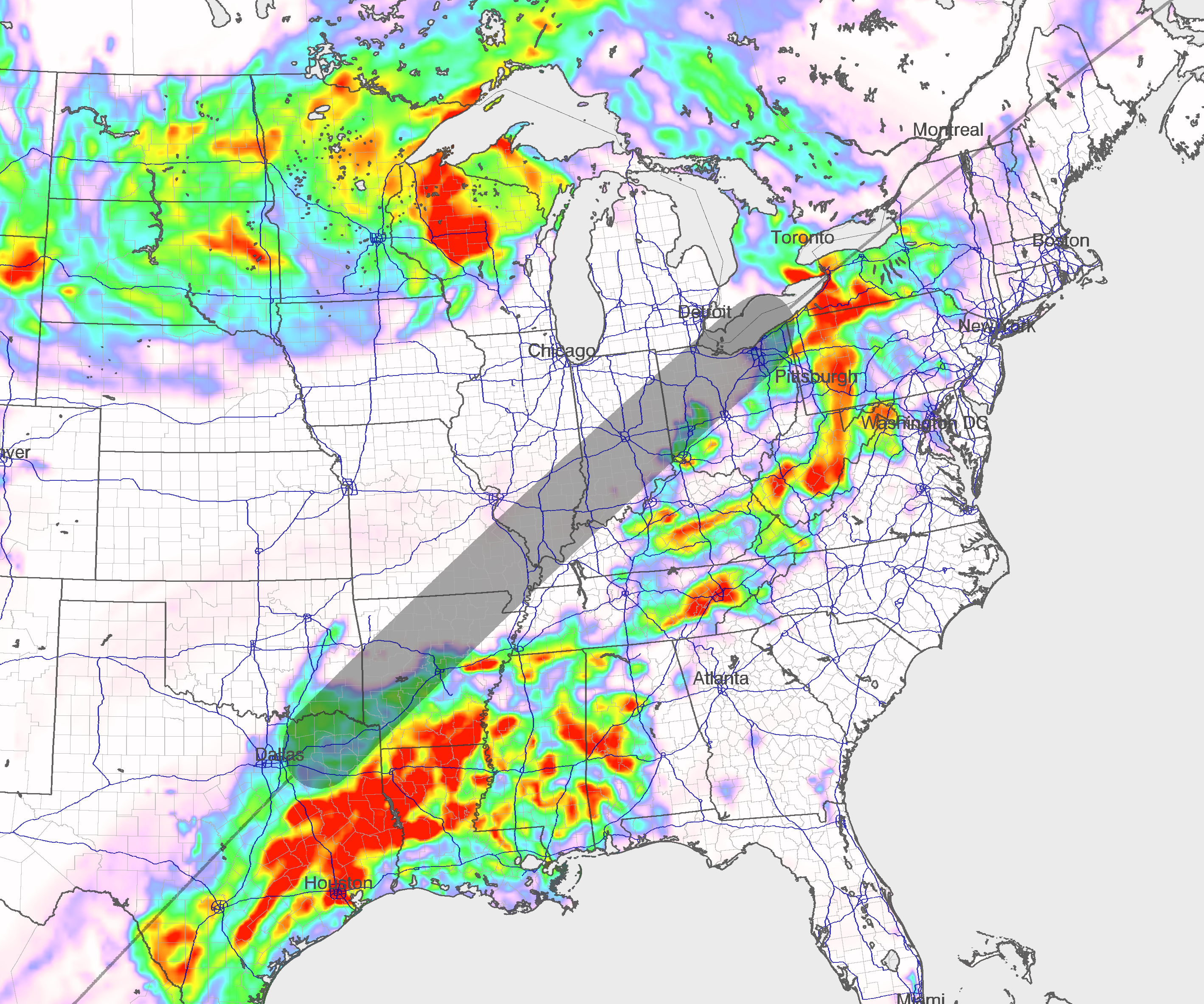
The Global Modeling and Assimilation Office (GMAO) is a component of the Earth Sciences Division in Goddard's Sciences and Exploration Directorate. mosaic of GMAO plotsOur research and development activities aim to maximize the impact of satellite observations in climate, weather and atmospheric composition prediction using comprehensive global models and data assimilation. To achieve this goal, the GMAO develops models and assimilation systems for the atmosphere, ocean, and land surface, generates products to support NASA instrument teams and the NASA Earth science program, and undertakes scientific research to inform system development pathways.

What's New

A new GEOS-5 Technical Memorandum is now available
The NASA Technical Memorandum, TM—2012-104606-Vol28, by Andrea Molod and colleagues in the GMAO's model development group describes the climatology of atmospheric simulations with the Fortuna version of the GEOS-5 AGCM. This is the current public release version of GEOS-5 and the version that was used for the GMAO's CMIP5 simulations. The document summarizes an extensive evaluation of the mean climate of many simulated fields with available observational estimates from satellites and reanalyses. It also describes the evolution from the version of GEOS-5 used for MERRA to the Fortuna version.

GMAO adds two new products to its extensive suite of MERRA data
A new ocean surface diagnostics product and a new land surface diagnostics product have been added to the suite of MERRA data. The new ocean surface product is a 1-hourly, 2-dimensional ocean surface diagnostics product on a 2/3 by 1/2 degree grid. The product is also available as a monthly mean and seasonal product. A supplemental and improved set of hourly land surface hydrological fields ("MERRA-Land") on a 2/3 by 1/2 degree grid benefits from corrections to the precipitation forcing with a global gauge-based precipitation product and from revised parameter values in the rainfall interception model, changes that effectively correct for known limitations in the MERRA surface meteorological forcings.

See details about these new MERRA data products.

GMAO Support for the National Climate Assessment (NCA)
The GMAO is supporting the National Climate Assessment (NCA) by providing enabling tools of assimilated data sets that synthesize and integrate the existing satellite (and conventional) data streams for the EOS/Aura period. As an initial contribution, regional and sector-specific products have been derived from MERRA and are available from our NCA web page. Our plan is to develop products from an ongoing climate analysis using GMAO's integrated assimilation systems that will enable an on-going, permanent assessment capacity and capability.

Read more about GMAO's NCA efforts.

4th World Climate Research Programme International Conference on Reanalyses (ICR4)
Abstract Submission for the 4th World Climate Research Programme International Conference on Reanalyses (ICR4) is now open. The conference is scheduled for May 7-11, 2012 in Silver Spring MD. Major topics include: Reanalyses status and plans, data assimilation, observations, validation and metrics, along with discussions on international collaboration.

See the ICR4 Call for Abstracts.

GMAO starts GEOS-5 real time data production at ¼ deg horizontal resolution
The GMAO has started the real time GEOS-5.7.2 data assimilation production on August 19, 2011. The new system generates data products at ¼ deg horizontal resolution and of significantly improved quality, resulting from many advances made in both the model and analysis. The GEOS-5.2.0 data production will continue in parallel until the end of 2011, to allow GEOS-5 real time data users ample time to transition to the new products.

For more details, please visit the GMAO Products page.

GEOS-5 Forecasting Support for HS3 Campaign
The Hurricane and Severe Storm Sentinel (HS3) is a five-year mission specifically targeted to investigate the processes that underlie hurricane formation and intensity change in the Atlantic Ocean basin. HS3 is motivated by hypotheses related to the relative roles of the large-scale environment and storm-scale internal processes.

HS3 will utilize two Global Hawks, NASA Globalhawk UAVone with an instrument suite geared toward measurement of the environment and the other with instruments suited to inner-core structure and processes. Field measurements will take place for one month each during the hurricane seasons of 2012-2014.

The GMAO, in collaboration with the Atmospheric Chemistry and Dynamics Branch, NCCS and SIVO, are providing meteorological and chemical forecast support for aiding flight planning and data analysis in the field.

» Read more

News and Research Highlights

  • thumbnail of fig. 1a GMAO article in GRL on how active and passive microwave data improve soil moisture estimates is highlighted in EOS The paper, by Draper and colleagues, shows that assimilating satellite observations from active or passive microwave sensors into models can improve soil moisture estimates. The authors assimilated soil moisture derived from the active ASCAT and passive AMSR-E satellite sensors into a land surface model and assessed the resulting soil moisture estimates against in situ observations from 85 sites in the United States and Australia. They found that the active and passive microwave data both improved the model's soil moisture estimates in similar ways. Following the recent failure of AMSR-E, the new study shows that systems designed to assimilate AMSR-E soil moisture can switch to ASCAT data without loss of accuracy.
  • thumbnail of fig. 1a Assimilation of Terrestrial Water Storage from GRACE in a Snow-dominated Basin In a recent study, gravimetric measurements from the Gravity Recovery and Climate Experiment (GRACE) mission are used in a land surface model data assimilation framework to better characterize snow conditions in the Mackenzie River basin located in northern Canada. The assimilation of GRACE terrestrial water storage information into the Catchment land surface model improves snow mass estimates.